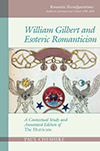
 William Gilbert and Esoteric Romanticism:
a Contextual Study and Annotated Edition of The Hurricane.
Paul Cheshire
(Liverpool University Press)
Now available reduced price paperback £21.96 from the publisher

William Gilbert and Esoteric Romanticism:
a Contextual Study and Annotated Edition of The Hurricane.
Paul Cheshire
(Liverpool University Press)
Now available reduced price paperback £21.96 from the publisher
Caines, Michael. ‘A Crack in his Story’, TLS Dec 7, 2018
A review of William Gilbert and Esoteric Romanticism which provides an excellent one-page introduction to Gilbert and all his works. Available online (paywall).
———————. ‘Who on earth was William Gilbert?’ Freedom, Books, Flowers and the Moon TLS podcast 6 Dec 2018.
Caines in conversation with TLS colleagues: a 15 minute bravura presentation (starts 2m 51s into podcast)
Cheshire, Paul. William Gilbert and Esoteric Romanticism: a Contextual Study and Annotated Edition of The Hurricane, Liverpool University Press, 2018.
Presents the untold story of Gilbert’s progress from the radical occultist circles of 1790s London to his engagement with the first generation Romantics in Bristol. At the heart of the book is the first modern edition of The Hurricane, fully annotated to reveal the esoteric metaphysics at its core, followed by close interpretative analysis of this strange elusive poem.
———————. ‘William Gilbert’s Date of Birth’
A dispute with a rival astrologer in the Conjuror’s Magazine is used to establish Gilbert's date of birth. Available here.
Coleman, Deirdre. Romantic Colonisation and British
Anti-Slavery (Cambridge UP, 2005)
A good contextual view of the European attitudes to Africa and Africans.
Relevant here is Chapter 2 ‘The “microscope of enthusiasm”: Swedenborgian ideas
about Africa’ pp 63-105 which includes a view of The Hurricane from
that perspective.
Kaufman, Paul. ‘“The Hurricane” and The Romantic Poets’, English Miscellany 21, (1970), pp. 99-115.
This pioneering study was published before Gilbert's magico-astrological writings had been discovered; Kaufman surveys The Hurricane's influence on the romantic
poets, and recognises Gilbert's place within the general history of theosophy.
Oxford Dictionary of National Biography - Richard Garnett, ‘Gilbert,
William (1763?–c.1825)’, 2004 rev. S. C. Bushell, Oxford Dictionary of National
Biography. online edn (paywalled)
The 2009 online version gives a good
balanced account, but needs updating. The unpublished Robert Southey 1824 letter to W. Sidney Walker cited as a source of information has not been traced (see Appeal below).
Schuchard, Marsha Keith.
‘Rediscovering William “Hurricane” Gilbert: A lost voice of revolution and
madness in the worlds of
Blake and the Romantics’ available here.
A ground-breaking study, first presented in 1999, of Gilbert's previously unrecognised links with 1790s
millenarians, Freemasons, and Swedenborgians, and possibly William Blake.
Although subsequent discoveries have made this article
biographically unreliable in places, and some links are not sufficiently
substantiated, Schuchard's extensive specialist research ensures that her
article provides a vital introduction to the occult underworld that Gilbert
inhabited.
———————. ‘William “Hurricane” Gilbert and the wilder shores of Freemasonry: revolutionary winds from Antigua, America, England, and Nova Scotia to Africa.’
Schuchard's 2018 paper (updated to include 2019 discoveries) considers Gilbert within the context of international Freemasonry. Her view on the importance of Masonry to Gilbert is supported by the discovery of his 1824 announcement that his new edition of The Hurricane could be renamed ‘American Masonry’. Schuchard introduces a wealth of new archival material, and places particular emphasis on African-American masonry. Available on the Quatuor Coronati website.
Thomas, Sue. ‘Placing William Gilbert’s contributions to The World & Fashionable Advertiser’, The Wordsworth Circle 53: 2 Spring 2022. (paywalled)
In a note to ‘The Brothers’ William Wordsworth acknowledged that a description of a calenture in his Lyrical Ballads was based on ‘an imperfect recollection of an admirable one in prose, by Mr. Gilbert, Author of the Hurricane’. Sue Thomas has located this description in one of a series of thirteen articles called ‘The Commercial Academy’ that appeared under Gilbert’s authorship in 1787 in The World & Fashionable Advertiser. These articles also show that Gilbert in 1787 had not developed the opposion to the trade slave evident in his 1790 letter to The Bristol Mercury and that the article ’The Commercial Academic’ that he wrote for Coleridge’s Watchman (1796) was extracted and condensed from these 1787 articles.
———————. ‘Catastrophic History, Cyclonic Wreckage and Repair in William Gilbert’s The Hurricane and Diana McCaulay’s Huracan’, in Tracking the Literature of Tropical Weather: Typhoons, Hurricanes, and Cyclones, ed. Anne Collett et al (Cham: Palgrave Macmillan / Springer Nature, 2017), pp. 227–50. online edn (paywalled)
This timely addition to William Gilbert scholarship looks at Gilbert’s poem within the genre of Caribbean tropical storm literature. The cataclysmic history of the Caribbean — European invasion, genocide of indigenous people, introduction of enslaved Africans, and the resulting commercial exploitation — is mirrored by the cataclysmic destruction caused by its hurricanes. Thomas detects brilliantly the Caribbean resonances present in Gilbert's poem, which has previously only been studied from a Eurocentric perspective. Thomas’ new perspective shows how the crisis of the poem’s storm mirrors the many contemporary slave revolts, how Gilbert’s ‘genii of the deep’ are drawn from pre-Columbian ‘mythological and theological’ understandings of the ‘experience of disaster’, and how Gilbert’s avenging spirits beneath the ocean have their counterparts in the Vodoun (voodoo) beliefs introduced to the Caribbean by the enslaved Africans.
‘William Gilbert’s Hurricane’, Retrospective Review 10 (1824), (London:
Charles Baldwyn) pp.160-172.
This is the only known literary study of Gilbert and his work from the
nineteenth century. Its anonymous author claims to have been provided with
information by someone close to the poet. ‘Of its author, William Gilbert, the
little we have collected is chiefly from the information obligingly furnished to
us by a distinguished literary character, an early friend of the author’s, and
by whose occasional notice of the work before us, concurring with a similar
testimony from another quarter, our attention was directed to The Hurricane.’
Much of this information appears in the DNB article, and with the coincidence of
the year 1824, which is also the date of the lost MS letter from Robert Southey
to W. S. Walker, it is highly probable that Southey is the source. Long extracts from
Gilbert’s poem are given; the analysis is brief but sympathetic.
A transcript of the lost 1824 letter from Robert Southey to W Sidney Walker, which is quoted as a source of information for the 1901 DNB article by Richard Garnett (see above), is laid in to the copy of The Hurricane formerly owned by him. It appears in a 1920 New York sale catalogue (Anderson Galleries). Neither the original MS nor any transcript of this letter are currently known. This vital source of information is out there somewhere.
Any books or articles containing substantive references to William Gilbert will gladly be added to this list.
Thanks to Sue Thomas and Kathy Callaway for input.